
Reliability. Expertise. Experience.
BugInfo Kft. provides bed bug treatment in rooms, flats and family houses in Budapest and Pest County. Residential treatment starts from HUF 19,900. Depending on the level of infestation and the site, we use spraying, cold fogging, heat treatment, dusting or a combination. We give a 4-week guarantee after the second treatment; if the bites continue, the third treatment is free. English-speaking service.
What do bed bugs, their eggs and droppings look like? – identification with photos
The photos below were taken during our own work in infested flats. Use them to decide whether what you have found is a bed bug.
The adult bed bug
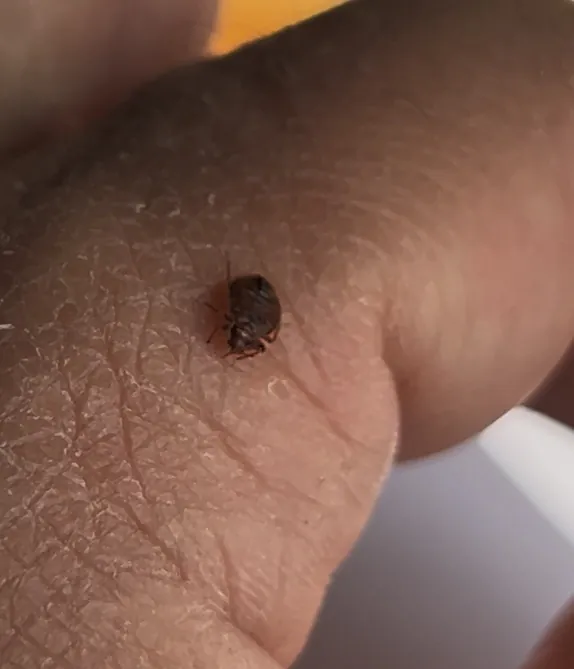
The adult bed bug is about 4–5 mm long – roughly the size of an apple seed. It is a flat, oval, wingless, reddish-brown insect. After feeding it stretches and swells, and turns dark red. Young bed bugs (nymphs) are 1–4 mm long and at first translucent and yellowish-white – before feeding they are almost impossible to spot.
Video: bed bugs feeding on a hand
Several bed bugs feeding on the back of a hand – this is what happens at night.
The video loads from videa.hu when you click play. Watch it on videa.hu
Bed bug eggs and droppings
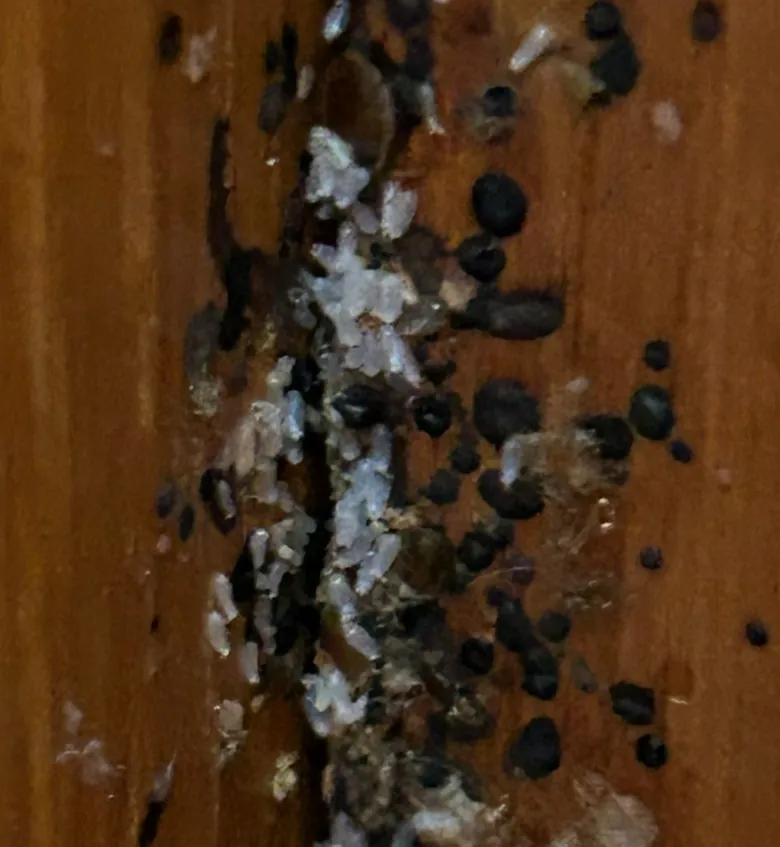
A bed bug egg is about 1 mm long, pearly white and shaped like a grain of rice. The female glues the eggs in groups into cracks, so they can't even be removed by simple vacuuming. The shells of hatched eggs stay matt white.
Bed bug droppings are tiny black-brown spots, as if someone had dotted the surface with a felt-tip pen. Because they are digested blood, they smear reddish-brown when wiped with a damp cloth. Where you find many eggs and droppings together, you have found the bed bugs' main hiding place.
Bed bugs at the edge of a carpet
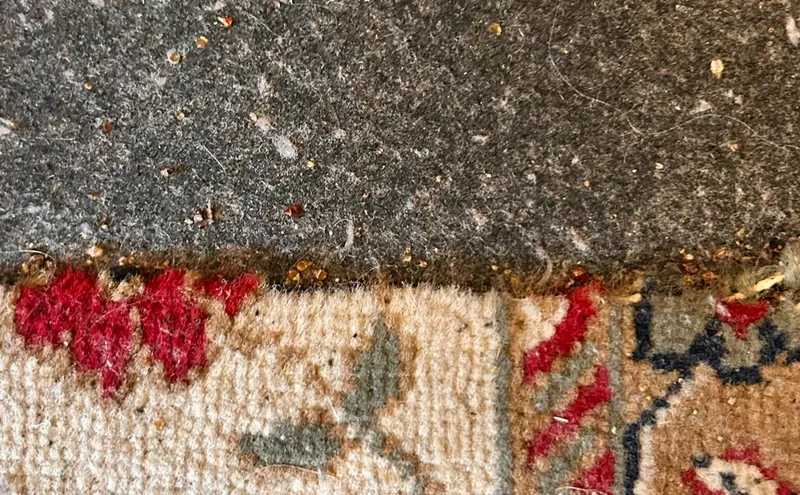
With heavier infestations, bed bugs no longer live only in the bed: they also hide along the edges of carpets, in furniture joints, behind skirting boards and in electrical sockets. The tiny, translucent brown shells are shed skins – nymphs moult five times as they grow. At this stage the whole flat needs to be treated, not just the bed.
An extremely infested bed
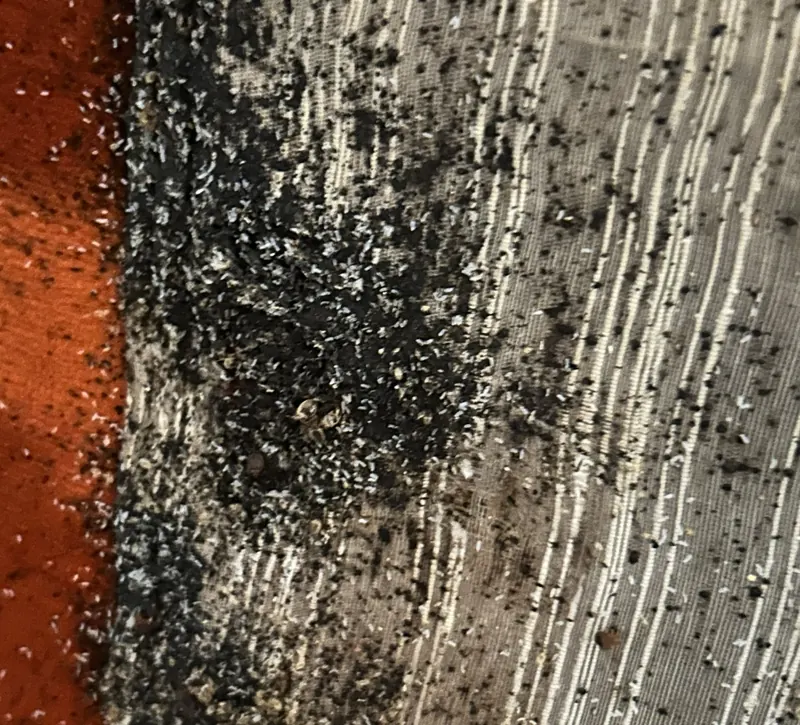
If an infestation is left untreated for months, the droppings form a continuous black layer along the seams and joints of the mattress and bed frame, with masses of white eggs and shed skins alongside. By then the bed bugs have spread to other parts of the flat – the sooner treatment starts, the faster and cheaper it is.
The adult bed bug is a flat, oval, wingless, reddish-brown insect, about 4–5 mm long – roughly the size of an apple seed. After feeding it stretches, swells and turns dark red. Young bed bugs (nymphs) are 1–4 mm long, at first translucent and yellowish-white, and only easy to see after feeding.
Tiny black-brown spots, as if someone had dotted the surface with a felt-tip pen. The droppings are digested blood, so they smear reddish-brown when wiped with a damp cloth. They are most often seen along mattress seams, on the bed frame, at the joints of the slatted base and around hiding places.
Mainly close to where people sleep: in mattress seams, in cracks in the bed frame and slatted base, and under the bed. With heavier infestations they are also found along the edges of carpets, in furniture joints, behind skirting boards, in electrical sockets and behind picture frames.
There are several signs of bed bugs: bites on your body, tiny black or brown spots on the bed frame and furniture, strange blood stains on the sheets – like when you swat a mosquito and smear it – and shed bed bug skins. Whichever you see, it is worth starting to search. Check the mattress and bed frame first. If you can, turn the bed over and look at it from underneath too. The sneaky little bed bugs often hide where you can't see them from above or from the side.
Everyone reacts differently to bed bug bites. There are two extremes: in one, nothing appears on the skin at all; in the other, pus-filled inflammation develops where the bites are. Bed bug bites are easy to recognise because several bites are lined up in a row. This is because the bed bug does not climb onto the person while feeding. But if the person moves even slightly (perhaps just a tiny muscle twitch during sleep), it stops feeding and then starts again until it is full. That is why one feed can leave 5–10 bites.
At BugInfo Kft. we particularly like to use heat treatment as a complementary method. Unfortunately, heat treatment cannot be used on every surface, so our technician decides on site whether it can be used. Its biggest advantage is that it gets enough heat into cracks and crevices to kill bed bugs and eggs that even a vacuum cleaner can't reach. It drastically reduces the number of bed bugs hatching in the following weeks and those already hatched, so there are far fewer bites before the second treatment than without heat treatment.
Very good insecticides for home use are available in shops, for example Protect bed bug killer by Bábolna Bio, or Bio Kill. The problem with these products is not their quality but how they are used. People don't treat every surface a professional would. Often you don't even think of all the places where bed bugs can hide. Because of local, non-comprehensive treatment, the bed bugs move from their original hiding places to somewhere else, which makes the professional's job harder. We use 2–4 litres of insecticide to treat one room. That is 4–8 bottles, which costs about as much as a professional's labour. If you don't want to pay twice, go straight to a professional.
Thanks to the application method and the ingredients, the products we use (spraying) only harm the target organism.
What does this mean? They do not affect small children, pets, cats, dogs, fish in aquariums or reptiles. It is best to keep animals out during the treatment, but once the product has dried they can safely be in the treated rooms. For air-space treatment (fogging), animals must be taken out for a set time – at least 2–3 hours.
Bed bugs grow to a maximum of 7–8 mm (fully fed). First-stage bed bugs are barely visible to the naked eye. If your eyesight isn't perfect, I suggest using glasses or a magnifying glass when you look for bed bugs.
Bed bugs reproduce by laying eggs. A fertilised female can lay 2–4 eggs a day and up to 300–500 eggs in her lifetime. The new bed bugs hatch from the eggs after 2–5 weeks. How long hatching takes depends on temperature and humidity. Below 13 °C and above 40 °C their development stops.
A bed bug egg looks like a grain of rice, but even smaller: about 1 mm long and 0.5 mm wide, glossy white. Before the bed bug hatches, there are two dots at the front end. Once it has hatched, the dots disappear and the egg turns matt white.
Bed bug eggs can be destroyed in three ways: physical removal, heat treatment or fumigation. Fumigation cannot be done in a home, so let's not even discuss it. There are various fogging methods that people often wrongly call fumigation, but they are not, and they do not kill the eggs. Physical removal is sometimes almost impossible, because bed bugs lay their eggs in tiny cracks and crevices you can't reach. With heat treatment you have to be very careful that the heat does not damage the surface or start a fire, and that the heat is applied for long enough.
Because mopping and cleaning should be avoided for a few days after the treatment, it is worth mopping, vacuuming and tidying thoroughly before it. It is FORBIDDEN to put used clothes, bedding or anything else that may have bed bugs into wardrobes or anywhere else.
If you pack things up and take them away, they must be packed so that bed bugs cannot crawl out, and you must not touch them for at least 6 months. If they had bed bugs and come back into the flat a few months later, the flat will be infested again. Very thorough vacuuming of the furniture and the whole room helps the treatment, because it physically removes bed bugs. Pay special attention to the vacuum bag: remove it from the vacuum cleaner after vacuuming and seal it in a plastic bag so the bed bugs can't crawl out. Besides removing adults, vacuuming and brushing the furniture – especially the corners and edges of the bed, sofa and armchairs – helps remove eggs. Vacuuming and brushing are useful because they drastically reduce the number of bites and newly hatched bed bugs between the two treatments.
There are several kinds of bed bug traps, both active and passive. Some are simply sticky, others also contain pheromones. At the moment I can't honestly recommend any trap that catches all the bed bugs. These traps are mostly good for monitoring. Even so, they don't always show the real situation. Each type has its pros and cons – for example, pheromone traps only work for a few weeks, and the glue in electric traps gets dirty after a while. One thing is certain: you cannot get rid of bed bugs with traps alone.
Prevention plays a very important role in pest control. Even so, when it comes to preventing bed bugs, I usually say it takes far more effort and causes far more inconvenience than being infested once every 2–3 years. Re-infestation happens very rarely, but it does happen. Of course, anyone who works somewhere with a high risk of re-infestation should introduce a few new rules: check clothes and bags at work or when arriving home; when travelling, check the mattress and its surroundings on arrival at the hotel; and check used or new items when you buy them (furniture, books, carpets, pictures, etc.).
It is even more important to find out where the bed bugs came into the flat from, and to avoid bringing them in from there again and again.
Getting rid of bed bugs is a long process. On average it takes 4–6 weeks to make a room bed bug-free. You can try to get rid of them yourself, but it is very difficult. You can save yourself a lot of time and energy by going straight to a professional. I have seen people who managed it, but I have met more who didn't. They could have saved a lot of money – and, more importantly, their suffering would have ended sooner – if they had gone straight to a professional.
Bleach such as Domestos is not really effective against bed bugs. It would only work if it came into direct contact with the bed bug in a very high concentration. The same is true of any other disinfectant or cleaning product. Bleach and products like Well Done or Sanytol would only slightly reduce a bed bug population with direct contact and in large quantities – they would not solve the problem.
I won't go into home remedies. If you like experimenting, you can try fighting bed bugs with garlic, onion, baking soda, lavender or any other plant containing essential oils. I wouldn't try these methods, because there is no evidence that they work. Bed bugs lay 2–4 eggs a day, so in one week of delay a single female can lay up to 28 eggs. And that's just one female.
With us, bed bug treatment takes about 25 minutes for 1 room and about 45 minutes for 3 rooms. When spraying (chemical treatment), the whole room is treated. Among other things: we turn the bed over, spray around the wardrobes, and treat every seat, door frame and window frame. If possible and if you order it, we carry out heat treatment before spraying. And if we think it necessary, we finish with cold fogging (often called "gassing", although it has nothing to do with fumigation).
This is perhaps the one step in preventing future re-infestation that you really must take. Bed bugs spread in two ways: actively or passively. Passive spread is typical – it means you carried the bed bugs into the flat with something, such as clothes or items (furniture, books, carpets, pictures, etc.). They only spread actively if they multiply too much and don't get enough food, or if their food source disappears for a longer time and they sense another one nearby. A typical case inside a flat: you move from one room to another, and after a few nights the evening feast starts there too. It is important to find out where the bed bugs came from. If you know the original source (relative, friend, neighbour, workplace, public transport, hotel, etc.), you can avoid bringing them in from there again. In that case it is worth telling the people who work or live there what you have found, so they can take action too.
Don't – bed bugs hide not only in furniture and belongings but in other parts of the room too: in cracks in the walls, behind light switches and sockets, in door and window frames and in other places where throwing things away won't remove them. If you do decide to throw things away, do it so that nobody else can use them. Destroy the mattress – cut it up – and write on the bags and sacks that they contain bed bugs. If you don't, you will infest other people.
Bed bugs spread very insidiously. In most cases, by the time you notice them, you have already been living with them for weeks or months. During that time they have plenty of opportunities to spread elsewhere. Your responsibility begins when you realise your flat has bed bugs. From that moment, you must be very careful not to infest anyone else! Having guests over is not really recommended, but if it can't be avoided, take precautions so they don't take bed bugs with them. When leaving, guests should check their clothes, put all worn clothes straight into the washing machine when they get home, and carefully check their bags and suitcases.
This is completely normal. Unfortunately, treatment is a long process – it takes 6–8 weeks for the problem to disappear completely. Bed bugs sprayed directly during the treatment can die within 5–10 minutes, but sometimes only after days. How quickly they die depends on their condition: when they last fed, when they last moulted, how many eggs they have laid, and the environmental conditions. In general, bed bugs that appear even in broad daylight after the second treatment (no longer very nimble, and clearly not having fed recently) are already dying. These bed bugs no longer feed and can no longer reproduce. So if you see one like that, it means the insecticide is working.
You must wait until the flat is free of bed bugs. There is no point repainting before then, because bed bug marks can appear on the fresh paint if the room is still infested.
In this situation I usually suggest acting as the bait: lie down in the bed where you normally sleep, ideally on a white sheet without other bedding (duvet, pillow). Lie still for 20–30 minutes, at most an hour, and the bed bugs will appear on the white sheet. You don't have to sit in total darkness – a small night light or light coming in from a distance is fine. If the first night brings no result, repeat it over the next 2–3 nights.